Morpho UV Printer: Prices, Both Models, and the Live Kickstarter
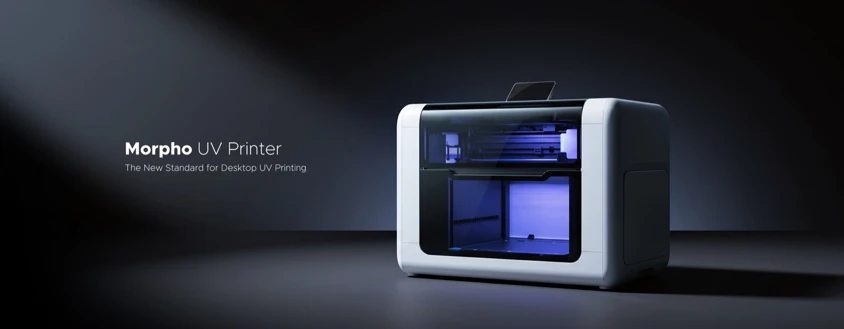
The Morpho UV printer opened on Kickstarter on August 20 and was past $6 million a day later. It starts at $1,599 for an enclosed moving-gantry machine with stereo vision alignment, an open ink system, and up to 60 mm of stacked texture. Here's what separates the two models and what backing it now involves.

Contents
- What's new
- Two models, $1,200 apart, and the difference is the printhead
- What both models share: an enclosed gantry, four cameras, open ink
- Texture stacking up to 60 mm
- The first ink price: $39.99 for 290 ml of white
- Color and safety: the two certifications
- Who's behind Morpho
- The deposit is gone, and a pledge is the only way in
- Morpho vs the desktop UV field
- Should you back it?
- What to watch next
- Frequently asked questions
Morpho, the desktop UV company founded by DJI's former camera chief, put its printer on Kickstarter on August 20, 2026, and a day later stood above $6.4 million from more than 1,800 backers. It had asked for $50,000. Funding runs to October 14.
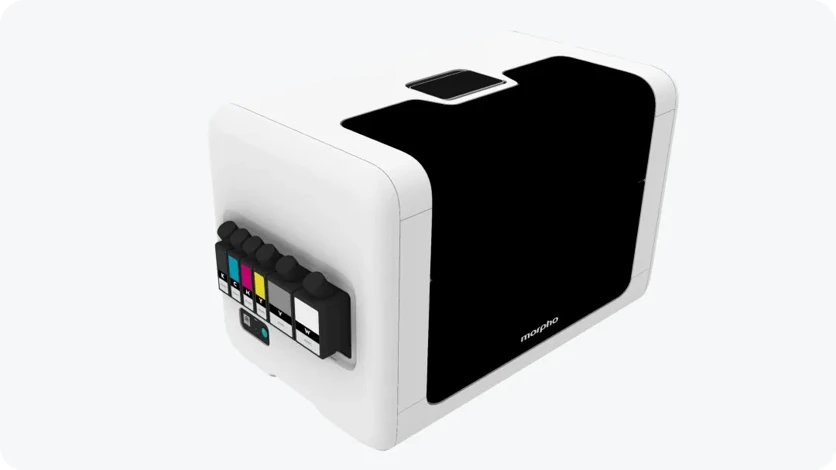
The machine is the one announced in July, in two models that differ almost entirely by printhead: the standard Morpho UV Printer (F1080) at $1,599 and the Morpho UV Printer Pro (i3200) at $2,799. No desktop UV flatbed has started lower, and what sits behind that price is more ambitious than it suggests: an enclosed moving-gantry design, four cameras, a built-in spectrophotometer, and an open ink system. The $50 deposit that held those prices through the summer is closed. Here's what the machine does, what separates the two models, and what backing it involves.
What's new
August 21, 2026. The Kickstarter is live, and the $50 deposit route this page described all summer is finished: Morpho's store page for it now redirects to the campaign, taking the FAQ that carried the Q4 2026 shipping line with it. The prices below stay as Morpho published them before launch, marked Super Early Bird throughout.
July 14, 2026. Morpho spent two hours on camera, and the picture filled in. On its July 13 livestream the company said it has around 200 engineers across computer vision, chemistry, software, image algorithms and physics, that core functions and the RIP run locally with no cloud requirement (cloud credits only power the AI relief effects), and that a soft, flexible ink and a roll-to-roll UV DTF accessory are in development. It re-affirmed the no-cleaning-cartridge design, and both spec pages now say it plainly: the launch-day rows listing cleaning and moisturizing cartridges are gone. Morpho expects the Kickstarter to go live in August. The machine demos live at Open Sauce in San Francisco on July 17, then in Europe the following month.
July 4, 2026. Two of the launch-day open questions resolved. Morpho's spec pages stopped disagreeing with themselves: the "Max Embossment Height: 5 mm" row is gone, and both the homepage and the prelaunch table now list 60 mm for both models. And shipping guidance is now official: the estore FAQ says Morpho "is currently expected to start shipping in Q4 2026." For where the two Morphos land against everything else, see our best desktop UV printer comparison.
July 2, 2026. Morpho issued its launch press release (GlobeNewswire, New York dateline). The two-model spec table had been live on morpho.inc since mid-June, the $50 deposit product on its Shopify store since June 9, and the machine itself was first shown publicly at Maker Faire Long Island on June 6, then at the Midwest RepRap Festival the following weekend. This page launched on announcement day with the verified pricing, the printhead breakdown, and the field comparison.
Two models, $1,200 apart, and the difference is the printhead
| Model | Super Early Bird | MSRP | Printhead | What it adds |
|---|---|---|---|---|
| Morpho UV Printer (F1080) | $1,599 | $2,699 | Epson F1080 (XP600), 1,080 nozzles | 1440 DPI, 6 ink channels (CMYK+W+V) |
| Morpho UV Printer Pro (i3200) | $2,799 | $4,999 | Epson i3200, 3,200 nozzles | 2400 DPI, 8 channels (CMYK+2W+2V), full-color 3D listed |
Prices from morpho.inc and the store FAQ, checked July 2 and re-verified July 14, 2026. These are the Super Early Bird prices Morpho published before its Kickstarter opened on August 20; they originally required the $50 deposit, which is no longer sold, and the campaign's own tier prices are the ones a backer pays today. MSRPs are Morpho's stated post-launch prices. All prices USD; Morpho publishes no EUR pricing, and EU buyers should budget VAT and import costs on top.
Morpho named its models after their printheads, which is unusually honest labeling, and it's the single most useful thing to understand about this machine. The rule carries beyond Morpho: in a desktop UV printer, the model number is the printhead. F1080 (or XP600, the same physical head) means a consumer-class part that sells for around $350 (about 300 EUR) as a replacement; i3200 means an industrial head at roughly $1,000. That one component decides resolution, speed, ink channels, and your biggest future repair bill. The parts gap is roughly $650; the rest of the $1,200 step-up buys the resolution and channel jump, and margin.
The spec table splits accordingly. The F1080 model prints at 1440 DPI from 1,080 nozzles across 6 ink channels (CMYK plus one white and one varnish), with a 4.5 pl minimum droplet. The Pro prints at 2400 DPI from 3,200 nozzles across 8 channels (CMYK plus two white and two varnish), with a 3.8 pl minimum droplet. Industry lifespan figures run 6-12 months for F1080-class heads against 1-2 years for the i3200; Morpho's own comparison table says 12 and 18 months, which the company has since rounded up to "about three times longer" for the i3200. The extra white channel matters more than it looks: white is the structural ink under every color layer and the whole material of raised texture, so the Pro should build relief noticeably faster.
Two model-split details worth knowing before choosing:
- The upgrade path goes up, not sideways. Morpho says the F1080 model's printhead can be upgraded to the i3200 later, so the $1,599 machine isn't a capability dead end. No upgrade price is published yet.
- Full-color 3D printing is Pro-only, "supported with specialty inks." Morpho hasn't shown a freestanding full-color 3D print yet or priced the specialty inks, so for now it's a roadmap item.
What both models share: an enclosed gantry, four cameras, open ink
Away from the printhead, the two models are the same machine, and several of its ideas are new to desktop UV printing at this price:
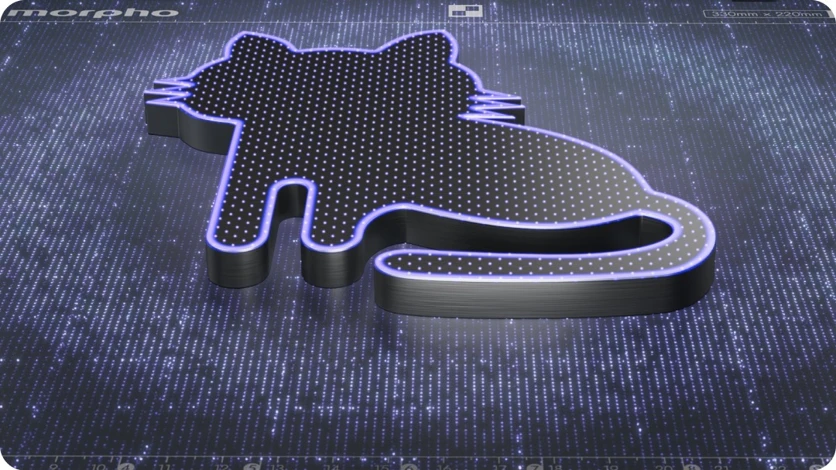
- Enclosed build area: 330 x 220 x 168 mm, extendable to 420 x 330 mm (A3+) with the A3 Printbed. The bed stays stationary and the gantry moves, so a 32 kg, 660 x 430 x 390 mm box encloses an unusually tall print volume. Morpho calls it "up to 4x more" enclosed space than conventional desktop UV printers; its own prelaunch graphic says 2.4x. Either way, the closed-lid clearance is the point.
- 168 mm of object clearance with the lid shut, and 10 kg of supported object weight. Tumblers, boxes, and tall blanks fit inside a closed, filtered enclosure rather than under an open gantry.
- 600 mm/s carriage motion, which Morpho calls 2x faster. The baseline, disclosed in its comparison table, is the 300 mm/s of generic single- and dual-F1080 desktop machines, not any brand-name rival. The "up to 9x faster" headline is really a Pro number against that same baseline: it stacks the doubled carriage speed on the 4.5x higher droplet rate Morpho cites for the i3200 head. The F1080 model gets the faster carriage but fires at the same rate as those baseline machines.
- Four cameras plus a laser: dual 8 MP stereo vision with infrared structured light for object alignment (a stated 0.2 mm accuracy), a 5 MP macro camera that scans real surface textures into printable reliefs (ReliefScan), a 2 MP live view camera, and a collision-avoidance laser. Placement is drag-and-drop on a camera view of the bed, with multi-object recognition for batch runs.
- A built-in spectrophotometer for color calibration and custom ICC profiles, hardware that normally lives in production print shops, not on $1,599 desktops.
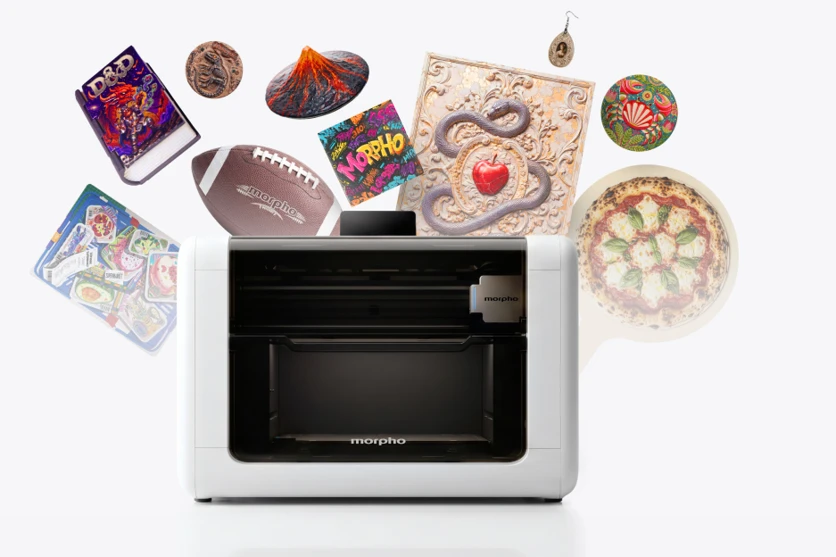
- Over 2,000 printable surfaces, by Morpho's count: wood, metal, acrylic, leather and glass, and finished goods like phone cases, mugs, keyboards and 3D prints.
- Refillable ink cartridges alongside proprietary ones, an open jig system, an SDK with access to controls and cameras, and open electrical interfaces for accessories. Taken together, that's the most open machine in the category, if it ships as described.
- Local-first software. Core functions and the RIP run on the machine or locally, with no cloud requirement; only the AI relief effects use cloud credits, and manual depth maps stay local. The software manages multiple printers, and the machine connects over Wi-Fi, Ethernet, or USB-C.
- EcoInk, under 50 dB(A), and indoor positioning: a low-odor, low-corrosive ink formulation with vendor-commissioned TUV testing behind the near-zero VOC figure, plus HEPA and activated-carbon filtration and UV shielding. Morpho puts its ink's odor and VOC emission at 10 to 20% of typical UV inks, says third-party test results are on the way, and plans to open the exhaust dimensions so owners can 3D print an adapter for external ventilation.

The official accessory list runs to a Rotary Jig for cups and bottles, an Electrostatic Mat, a Roll-to-Roll System, and the A3 Extended Print Bed. Morpho has since filled in details: the Rotary Jig auto-levels with cameras and lasers and detects handles, the mat holds paper-like material flat without vacuum, the roll-to-roll UV DTF accessory in development laminates in the same pass, the A3 bed is recognized automatically, and some jig designs will be open-sourced rather than sold. None of the accessories have published prices, and there's one packaging contradiction to watch: the estore's "what's in the box" list and its FAQ both include the A3 Printbed as planned contents (re-confirmed July 4), while the press release calls it an optional accessory. Worth a support email before you count on the bigger bed.
Texture stacking up to 60 mm
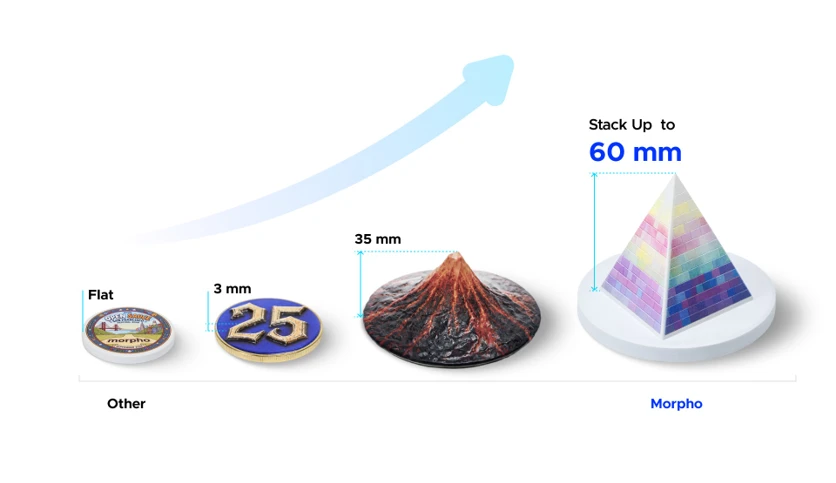
Every UV flatbed stacks ink into raised, tactile relief; the difference is how high. Desktop machines usually top out at a few millimeters. Morpho's homepage and press release list 60 mm, roughly ten times the usual desktop ceiling, and it's the most eye-catching number on the spec sheet.

Morpho has shown tall prints of its own, including the 35 mm volcano sample in its comparison graphic, already several times what desktop UV printers have demonstrated to date.
Physics explains why tall relief is slow work. UV relief builds in cured layers measured in tens to hundreds of microns, so a 60 mm build implies hundreds to over a thousand passes of white ink, which is hours of printing and a lot of ink per piece, and white-channel count is the throttle: two channels on the Pro, one on the standard model. The first print at full height with a time and an ink weight attached will show what the ceiling means in practice.
The first ink price: $39.99 for 290 ml of white
The first consumable price arrived with the deposit bonus: it values a 290 ml white ink cartridge at $39.99, which is about $140 per liter. CMYK, varnish and specialty ink prices are still to come, along with cartridge yields and printhead pricing, so a full cost per print will have to wait for the price list, and the "$413 value" of the 12 months of 20%-off ink coupons will be worth checking against it too. What settles it in the end is the same as for any print's true cost: material, machine wear, energy, labor, and failure rate.
Two structural points work in the buyer's favor here. The refillable cartridge option and open ink system mean bulk third-party UV ink is at least possible, an escape hatch closed-cartridge machines don't offer. And both printheads are the standard parts of the third-party UV world, so replacement heads have an open market price today: around $350 for the F1080 class, around $1,000 for the i3200, before any Morpho markup or discount.

The maintenance story has firmed up since launch. The spec table originally listed cleaning and moisturizing cartridges while the marketing promised none; as of July 14 both pages say the machine runs without either, and Morpho has explained the mechanics behind the promise: white-ink circulation and stirring with spitting routines against settling, a physical wiper designed to avoid color mixing, printhead heating to keep ink viscosity stable in cold rooms, a micro-camera that inspects test prints for clogged nozzles so software can compensate, and a replaceable waste-ink module. Morpho also says the formulation is its own, tuned to be less corrosive to the printhead, with refill bottles planned for heavier users and a soft, flexible ink in development that shouldn't need a full flush to switch to. Ink spent on maintenance is a real cost on every UV printer (Morpho models its savings at 61.9% to 98.8% against conventional designs), so a no-cartridge system, if it performs, is worth real money.
Color and safety: the two certifications
Morpho's spec table carries two third-party quality marks:
- "G7 Master ColorSpace Certified (Highest Level, Delta-E under 1.5)." G7 Master is issued by PRINTING United Alliance, and Colorspace is genuinely its most stringent level; "Highest Level" and the Delta-E figure are Morpho's own phrasing. The company leans on the same color story throughout: the built-in spectrophotometer, client swatches saved to a library and matched against golden samples, and soft proofing that previews the gap between screen color and printable color.
- "Greenguard Gold Certified EcoInk." GREENGUARD Gold is UL's chemical-emissions standard. The near-zero VOC figure rests on TUV testing Morpho commissioned, with third-party odor and VOC results promised on its social channels.
Who's behind Morpho
The founder story is a strong one, and it checks out. Morpho's press release introduces Mingyu (Brett) Wang as former VP of R&D and founder of DJI's camera division, and that checks out independently: his university's alumni profile records that he joined DJI in 2012, founded its camera team, was product manager of the Phantom 2 Vision drones, and was promoted to VP of R&D in 2015, leading a team of over 1,000. He also appears to be the founder of Zuvi, the consumer hardware startup behind the Zuvi Halo hair dryer and a three-category CES 2022 Innovation Award honoree, though no single source states both roles together. The hardware is real and publicly shown: the Maker Faire Long Island organizers billed Morpho's live-printing debut as a headline attraction on June 6, 2026, and the company livestreamed from the Midwest RepRap Festival a week later.
Morpho has also started describing itself at scale: around 200 engineers spanning computer vision, chemistry, software, image algorithms and physics, working on a machine it says was in development for years before the current desktop UV wave. "Physics-first engineering company" is the phrase it keeps returning to. Those are Morpho's own numbers and framing, but it's the first time the company has put a size to its team.
Morpho demonstrated the machine at Open Sauce in San Francisco on July 17, 2026, and said European demos would follow the month after.
The deposit is gone, and a pledge is the only way in
A pledge is charged when funding closes in October, not today.
Anyone who did put $50 down over the summer keeps a better deal than the one on offer now. Back with the same email, Morpho says, and the company returns $250, the deposit plus a $200 cashback, within 10 days of the campaign closing rather than waiting for the printer to ship. That took the F1080 down to an effective $1,399 and the Pro to $2,599. Backers arriving today have no deposit to refund and the cashback was tied to it, so they pay what the campaign charges.
Morpho also attached a bonus it values at $453 to the first 48 hours of funding: a white ink cartridge plus a year of monthly ink coupons. That window shuts on the morning of August 22, Pacific time, and the coupon half of it is pegged to a price list Morpho has not published.
The planned box is one machine, an A4 tray, the A3 Printbed (see the caveat above), a starter blank kit, and an ink set of 120 ml CMYK plus 290 ml white and varnish. Shipping is planned to the US, Canada, the UK, EU countries, Australia, Japan, China, and Singapore, all priced in USD, and the list has since widened to the Middle East and "most countries."
The usual crowdfunding caution survives the funding total. Pledges are charged at the end, ship windows are estimates that carry no penalty, and Morpho has not shipped hardware under its own name before. Six million dollars buys tooling and parts, not a delivery date.
Morpho vs the desktop UV field
The desktop UV category is having a crowded summer, so here's where the two Morpho models land in it:
| Machine | Price (US) | Max relief | Ships |
|---|---|---|---|
| Morpho UV Printer (F1080) | $1,599 SEB ($2,699 MSRP) | Up to 60 mm | Funding to Oct 14, Q4 2026 per Morpho |
| Morpho UV Printer Pro (i3200) | $2,799 SEB ($4,999 MSRP) | Same as above | Funding to Oct 14, Q4 2026 per Morpho |
| xTool O1 Omni, Single UV | $1,699 early bird ($2,499 MSRP) | 7 mm | Aug 2026 target |
| xTool O1 Omni, UV + DT Fabric | $2,799 early bird ($3,499 MSRP) | 7 mm | Aug 2026 target |
| eufyMake E1 | $2,499 / $3,299 | 5 mm | Now, 1-3 days |
| HeyGears G1 Starter | $1,699 VIP ($2,699 MSRP) | 5 mm | Kickstarter July 2026 |
| HeyGears G1X Full-3D | $3,299 VIP ($5,499 MSRP) | Full-color 3D to 130-150 mm | Kickstarter July 2026 |
| OMTech Spectra A3+ (dual head) | $4,799.99 | 5 mm | Late July 2026 |
The two Morpho rows were updated on August 21, 2026, when its Kickstarter went live; SEB = the Super Early Bird price Morpho published before the campaign opened, which required the $50 deposit that is no longer sold. Competitor prices and ship dates were checked July 2, 2026 on official stores and have not been re-verified, so the July and August targets in the Ships column are the ones those makers gave then. The Mimaki 3DUJ-2207, the industrial full-color benchmark, remains around $50,000.
Where that leaves the two Morphos:
- $1,599 is the cheapest entry in the field, and the slowest. The Morpho F1080 undercuts the xTool O1 Omni Single UV and the HeyGears G1 by $100 and the eufyMake E1 by $900, while promising a bigger enclosed volume, stereo vision alignment, and an open ink system. The catch is the calendar: xTool was targeting shipments for August while Morpho was still opening its campaign, so $100 saved buys a wait of unknown length.
- At $2,799 the Pro competes on a different axis than xTool's $2,799. Same money, different bets: the O1 Omni UV + DT Fabric buys a second fabric printhead and apparel printing (DTG and DTF); the Morpho Pro buys the industrial i3200 head, 2400 DPI, and dual white channels for texture work. Fabric business: xTool. Fine-detail rigid goods and relief: the Pro's pitch, on paper. And if the goal is freestanding full-color 3D objects rather than surface printing, the HeyGears G1X Full-3D Pack at $3,299 VIP is the machine advertising exactly that, with a resin system behind it.
- On ink, Morpho's one published number lands mid-field, and the field just moved. Its $39.99 for 290 ml of white is about $140 per liter, against xTool's roughly $83-120. The eufyMake E1, long the expensive end at about $430 per liter, cut to about $300 on July 13, with subscriptions near $200. The refillable-cartridge option is still the bigger deal than any sticker: none of the launch-wave rivals offer an open ink path.
- Need a machine now: nothing here has changed. The eufyMake E1 was shipping in 1-3 days when we checked its store in July, with a year of reviews behind it. A funded Kickstarter does not compete with a printer already on a bench.
Should you back it?
The case for pledging is the hardware. An industrial i3200 head is rare at this end of the market, shared in this field only with the HeyGears G1X, and none of the others enclose a 168 mm object with the lid shut. The case against is that all of it is still on paper. Nobody outside Morpho has printed 60 mm of relief and reported what it cost in time and ink, the published ink prices stop after white, and the company has never shipped a machine to a customer.
Pledge if you want this machine enough to have the money out of your account from October until a box turns up, and read the tier price on the campaign before you commit, because the prices on this page are the ones Morpho published before it opened. Buy something else if you need a UV flatbed printing this quarter, because this one will not be.
What to watch next
In the order they should land:
- The delivery month on the campaign's own pledge tiers, and whether it matches the Q4 2026 Morpho gave before launch
- First hands-on reports from outside the company, after July's Open Sauce demo and the European ones that followed
- The full ink price list (CMYK, varnish, specialty and soft inks) and cartridge yields, so a real cost per print can finally be worked out
- A third-party 60 mm print with a time and an ink weight attached
- The promised third-party VOC and odor test results, plus G7 and GREENGUARD directory listings
- Printhead upgrade pricing and the accessory prices (Rotary Jig, Roll-to-Roll, Electrostatic Mat)
Frequently asked questions
Is the Morpho UV printer Kickstarter live?
Yes. It opened on August 20, 2026 against a $50,000 goal, and a day later stood above $6.4 million from more than 1,800 backers, with a 'Project We Love' badge from Kickstarter on the page. Funding runs until October 14, 2026, and pledges are charged at the end of that rather than up front.
How much does the Morpho UV printer cost?
Two models. The Morpho UV Printer (F1080) at $1,599 (MSRP $2,699) and the Morpho UV Printer Pro (i3200) at $2,799 (MSRP $4,999), which are the Super Early Bird prices Morpho published before its Kickstarter opened on August 20, 2026. Those prices originally required a $50 deposit, which is no longer sold. All pricing is USD only.
What's the difference between the Morpho F1080 and the Morpho Pro i3200?
The printhead, mostly. The $1,599 F1080 model uses a 1,080-nozzle consumer-class Epson head (1440 DPI, 6 ink channels, 4.5 pl droplets); the $2,799 Pro uses the industrial 3,200-nozzle Epson i3200 (2400 DPI, 8 channels including dual white and varnish, 3.8 pl droplets) and lists full-color 3D printing with specialty inks. Everything else, the enclosure, cameras, bed size and software, is shared, and Morpho says the F1080's head can be upgraded to the i3200 later at an unpublished price.
When does the Morpho UV printer ship?
Morpho's last public guidance was Q4 2026. Its store FAQ said before the campaign opened that shipping was 'currently expected to start in Q4 2026,' with the timeline dependent on production progress, and Morpho has not repeated that date on morpho.inc since. Shipping is planned to the US, Canada, UK, EU, Australia, Japan, China and Singapore, plus the Middle East and 'most countries' per Morpho, with Batch 1 priority for the summer's depositors.
Can I still pay the Morpho $50 deposit?
No. The deposit was a pre-launch reservation and Morpho stopped selling it when the campaign opened, so a pledge is the only route in. Anyone who paid it keeps the terms Morpho published: back the campaign with the same email and the company says it returns $250, the deposit plus a $200 cashback, within 10 days of the campaign closing, which takes the F1080 to an effective $1,399 and the Pro to $2,599.
Is the Morpho UV printer a 3D printer?
No. It's a UV inkjet that prints color, texture and relief onto existing objects, up to 168 mm tall and 10 kg, on more than 2,000 surfaces by Morpho's count. Its raised texture is stacked ink, rated up to 60 mm on both models' spec tables, and Morpho has shown tall printed samples like the 35 mm volcano in its comparison graphic. The Pro model additionally lists 'full-color 3D printing with specialty inks,' but Morpho has shown no freestanding 3D print; for that capability today, see the HeyGears G1X.
How big can the Morpho UV printer print?
330 x 220 mm with the lid closed (168 mm object clearance), extendable to 420 x 330 mm, which is A3+, with the A3 Printbed. The estore's box list includes that A3 Printbed while the press release calls it an optional accessory, a contradiction Morpho hasn't resolved. Objects up to 10 kg fit inside the enclosure on a stationary bed under a moving gantry.
How much does Morpho ink cost?
One data point exists: Morpho values its 290 ml white cartridge at $39.99, about $140 per liter. CMYK, varnish and specialty ink prices, and cartridge yields, are unpublished, so there's no way yet to work out what a print will cost. The machine takes refillable cartridges alongside proprietary ones, which leaves the third-party ink door open; refill bottles for heavier users and a soft, flexible ink are planned.
Can the Morpho UV printer really print 60 mm tall textures?
Morpho's spec pages say up to 60 mm for both models, and Morpho has shown tall printed samples, including the 35 mm volcano in its comparison graphic. Tall relief is slow work by nature: 60 mm of stacked UV ink means hundreds of passes and real ink per piece, so independent timed prints will show what the ceiling means in day-to-day use.
Who makes the Morpho UV printer?
Morpho Inc (morpho.inc), a company whose founder, Mingyu (Brett) Wang, verifiably founded DJI's camera division and served as its VP of R&D from 2015, and appears to also be the founder of Zuvi (the Halo hair dryer). The company says it has around 200 engineers across vision, chemistry, software and physics, with Wang as its public face. It's a different company from the Japanese imaging-software firm Morpho, Inc. (morphoinc.com); neither company's materials mention the other.
Should I buy the Morpho UV printer or the eufyMake E1 or xTool O1 Omni?
Need a machine now: the eufyMake E1 ($2,499) ships in 1-3 days with a year of reviews and, since July 13, ink prices cut about 30%. Want apparel printing: the xTool O1 Omni UV + DT Fabric ($2,799 early bird) is the only one that prints fabric. The Morpho's case is price ($1,599 entry), the industrial i3200 head option, the enclosed 168 mm clearance, and the open ink system, all of it still on paper until the ink prices publish and independent tests arrive.
Sources
- morpho.inc, for the two-model spec table, both prices and their MSRPs, the deposit reward breakdown and the texture-height comparison graphic. Images are Morpho's official product media
- Morpho's Kickstarter campaign, for the live funding total, the backer count, the $50,000 goal and the October 14 deadline
- Morpho's deposit page, now redirecting to the campaign, for the deposit terms, the cashback and 48-hour bonus mechanics, the box contents, the shipping countries and the Q4 2026 shipping line
- Morpho's prelaunch page, for the printhead lifespan figures and the 300 mm/s baseline it compares against
- Morpho's launch press release on GlobeNewswire, for the 60 mm texture figure, the founder background, the TUV VOC testing and the A3 Printbed called optional
- Morpho's launch livestream of July 13, 2026, for the team size, the local-first software, the maintenance mechanics behind the no-cartridge claim, the VOC figure and the demo dates
- Epson's printhead datasheets for the i3200 and F1080 specifications, and parts vendors for the open-market replacement prices
- PRINTING United Alliance, for the G7 Master certification scope and levels; no Morpho listing appears in its directory
- HKUST's alumni profile, for Mingyu Wang's DJI camera-division and VP of R&D history
- Maker Faire Long Island's organizers, for Morpho's June 6, 2026 public debut
- The official stores of eufyMake, xTool, HeyGears and OMTech, for the competitor prices in the comparison table
Share this article
Related articles
UV Printers · Jul 4, 2026
The Best Desktop UV Printer in 2026: Every Machine Compared
Desktop UV printers now share the same desk, from $1,599 to $9,299. The field moved again this month: eufyMake cut its ink prices about 30%, and four challengers are heading for launch. Here is the whole sub-$10,000 field as of July 2026: what each machine prints, what the ink costs per liter, and which one fits which kind of work.
27 min read

UV Printers · Jun 29, 2026
xTool O1 Omni Printer: Prices, Editions, and Ink Costs
xTool says 'from $1,699' for a 4-in-1 that prints on wood, tumblers, and T-shirts. That number is a deposit-locked early bird on the single-head model, and the only edition that does all four jobs is $2,799. Here's every price, the published ink costs, and what it can't do.
19 min read
3D Printers · Jun 12, 2026
HeyGears G1 and G1X: Full-Color 3D Printing Gets a Desktop Price
Full-color 3D printing used to mean a $50,000 machine. HeyGears put it on a desk for $3,299. The three tiers print very different things, and HeyGears has now published the ink, resin and printhead numbers that decide the real cost of ownership. Here's every price, what each pack buys, and what it costs to run.
18 min read