Bambu Lab H3C Launches at $2,499 With Nine Docked Hotends
David Chacón7 min read
The Bambu Lab H3C parks nine hotends in a rack and warms the next one while the current one prints, which Bambu claims cuts a material change to about six seconds with almost nothing purged.
Contents
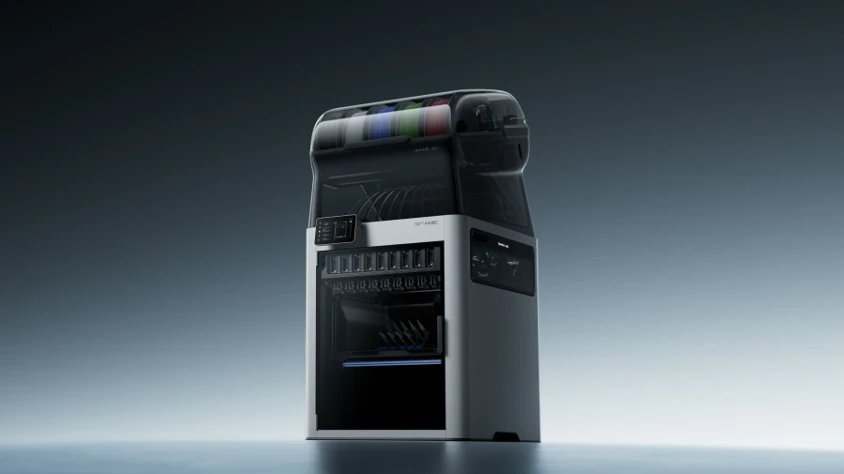
The Bambu Lab H3C with the AMS 3H filament unit on top. Image: Bambu Lab.
Bambu Lab has launched the H3C, a tool-changing 3D printer that parks nine hotends in a rack and warms the next one before it's needed, selling it as a $2,499 combo with its new nine-slot AMS 3H filament unit.
In Europe the same combo costs €2,499 as of November 3, 2026, and Bambu's EU store says orders leave its warehouse within one to three business days. The box holds the printer, the AMS 3H and nine PrintTools, one of them built for thicker TPU filament.
To me, the H3C is the most advanced multi-hotend printer on the market. Nine hotends mean nine colors or materials in one print, but the smarter move is supporting different nozzle sizes from day one. The thicker flexible-filament path should also take most of the headache out of TPU, even the very soft grades.
The AMS 3H matters more than it looks. On my Prusa XL I changed spools by hand so often that it became tedious, and that's the chore it takes over. My H2C, which I'm very happy with, takes around 40 seconds for a color and nozzle change, against the six seconds Bambu claims for the H3C. I've bought one to see how that holds up.
Nine PrintTools Stay Loaded and Warm
Each PrintTool is a hotend with its own heater, cutter and filament path, so nothing has to be pulled back before the next material goes in. On a single-nozzle printer, every change means retracting the old filament and flushing what's left through the nozzle; here the old material simply stays in its own hotend. Idle tools wait in a rack, and the next one heats up while the current one is still printing. Bambu claims a full material switch takes about six seconds and purges just 38 mg, both measured in its own testing with Bambu PLA in a filament-saving purge mode.
Bambu calls the mechanism SwapTek, and the spec sheet lists it as a hotend-switching system: a single FlexFeed extruder stays on the head while the PrintTools change, the approach described in the hotend-changing patent application published in August. Between changes the rack lifts out of view, leaving a clear look into the chamber.
Soft filament gets its own route. The FlexFeed extruder also accepts thicker flexible filament through a bypass feed, which buckles less on its way to the nozzle, and Bambu claims that lets TPU as soft as 75A print at up to three times the flow of its previous-generation machine on 1.75 mm filament.
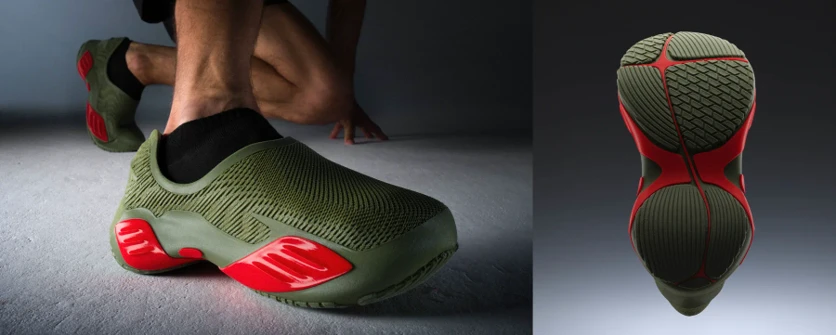
Bambu's BounceBerry X trainer combines flexible TPU grades in one print. Image: Bambu Lab.
Different nozzle sizes can share one print, and Bambu Studio gives each its own layer height, so a fine nozzle can draw the details while a larger one fills the bulk. The extra sizes are sold separately. Every nozzle is hardened steel, which the FAQ says stands up to carbon- and glass-fiber filament.
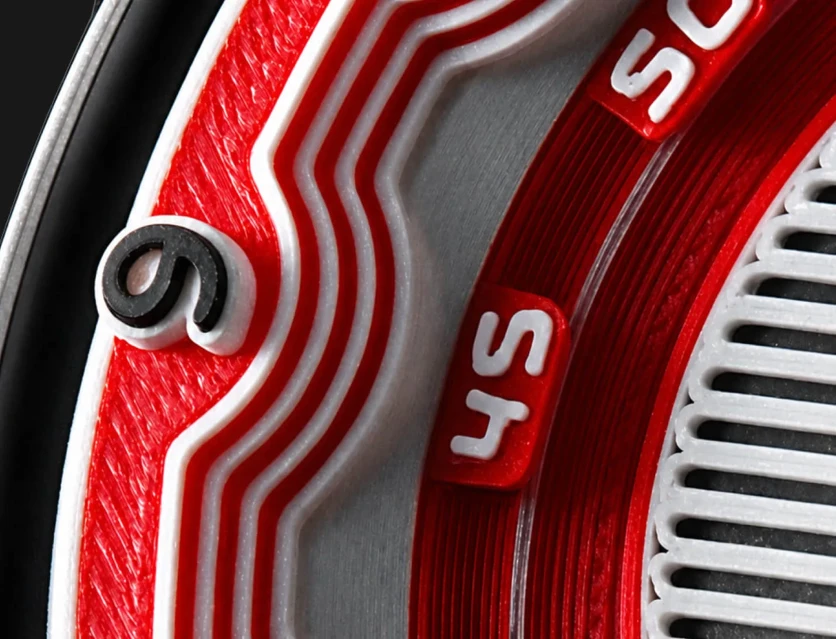
Bambu's watch demo prints the dial details with a 0.2 mm nozzle and the case with a 0.4 mm one. Image: Bambu Lab.
The AMS 3H keeps all nine spools sealed and loads them on its own, and Bambu says two of its slots double as a dryer hot enough for nylon and polycarbonate. Older AMS units can add more spools, but they feed through the first PrintTool, so those extra spools share that one hotend. Optional CutTool, DrawTool and DebossTool heads, sold separately, mount the same way and switch in automatically.
The H3C Is a Floor Machine
With the AMS 3H on top, the H3C stands just over a meter tall, so Bambu recommends the floor or a low, stable surface, with headroom for the AMS lid to open. Networking is wireless only, with no Ethernet port. The optional BirdsEye top camera is sold separately, and the monitoring features that use it aren't due until the first half of 2027, Bambu says.
| Spec | Bambu Lab H3C |
|---|---|
| Price (combo with AMS 3H) | $2,499 / €2,499 |
| Build volume | 330 x 320 x 325 mm |
| Tools | 9 PrintTools, 0.4 mm included; 0.2, 0.6 and 0.8 mm supported |
| Filament | 1.75 mm; 2.85 mm flexible filament via the bypass feed |
| Nozzles | Hardened steel, HRC 55+ |
| AMS 3H | 9 sealed slots, 2 of them drying at up to 85 °C; up to 24 spools with older AMS units |
| Max nozzle / bed / chamber | 350 °C / 120 °C / 65 °C |
| Max speed / acceleration | 1,400 mm/s / 25,000 mm/s² |
| Size with AMS 3H | 493 x 571 x 1,016 mm, 36.28 kg |
| Power printing PLA | 240 W (steady state) |
| Network | Wi-Fi 6, no Ethernet |
Bambu Lab's spec sheet and EU store, November 3, 2026. Steady-state power at 25 °C room temperature.
What an Hour of H3C Printing Costs
At the 3DPCC calculator's default rates, an hour of H3C printing costs about $0.34 before filament, and most of that is the printer's price spread over its working life.
| Cost | Per hour |
|---|---|
| Depreciation ($2,499 over 3 years at 50% uptime) | $0.190 |
| Maintenance ($70 a year) | $0.016 |
| Electricity (240 W at $0.23/kWh) | $0.055 |
| Subtotal | $0.261 |
| With the calculator's 30% buffer | $0.34 |
3DPCC calculator defaults in USD. In EUR, with €75 maintenance and €0.20/kWh, the total is €0.33.
The price is high next to most printers, but I don't think the H3C is expensive for what it does. For a business that prints in several materials, nine hotends that stay loaded mean far fewer jobs waiting on a spool change. If two materials are enough, the dual-nozzle H2D is still a very good machine, and the H2C covers the ground between two and nine. For a maker with the floor space for it, it's a fair choice at home too.
The real saving is in filament. I don't print much in multiple colors, but people who do can lose a large share of their margin to purge waste. Tool changers such as the Snapmaker U1, the Flashforge Creator 5 Pro and the Prusa Core One with Bondtech's INDX already cut that waste sharply, and the H3C does it with nine tools. If you print multicolor or multi-material jobs often, the filament you stop throwing away may well pay back part of the price.
I expect a smaller, cheaper machine with similar features before long. Mixing nozzle sizes in one print is what sold me on this one anyway, and I can't wait to try it.
The H3C Cleared the FCC in September
The H3C first appeared in the US Federal Communications Commission's equipment database as model PF008-P, with authorization granted on September 11, 2026. Bambu asked the FCC to keep the printer's photos, manual and test-setup images confidential. On October 22, a reader sent 3DPCC News an H3C teaser image showing a rack with nine numbered positions and the November reveal date.
Sources
Share this article
Related articles
3D Printers · Aug 15, 2026
Bambu Lab Patent Shows a Nine-Bay Hotend Rack
Bambu Lab's patent drops a hotend into the rack and releases it from the toolhead in the same movement. The drawings show nine bays, and only the hotend comes away. The extruder stays behind.
6 min read

3D Printers · Oct 12, 2026
Bambu Lab Announces S1 3D Scanner for November
The Bambu Lab S1 3D scanner is due in November 2026, with an official teaser showing the handheld design first seen in September's FCC records.
2 min read

3D Printers · Oct 22, 2026
Elegoo Unveils the M1 Ultra Handheld 3D Scanner
The Elegoo M1 Ultra is a handheld 3D scanner with an onboard touchscreen, aimed at turning existing objects into starting points for new designs.
3 min read