Bambu Lab R1 Launches With a 55W CO2 Laser and Automatic Alignment
Bambu Lab's first dedicated laser cutter brings automatic beam alignment, camera-assisted positioning and 1,000 mm/s engraving to a 55 W CO₂ machine.
Contents
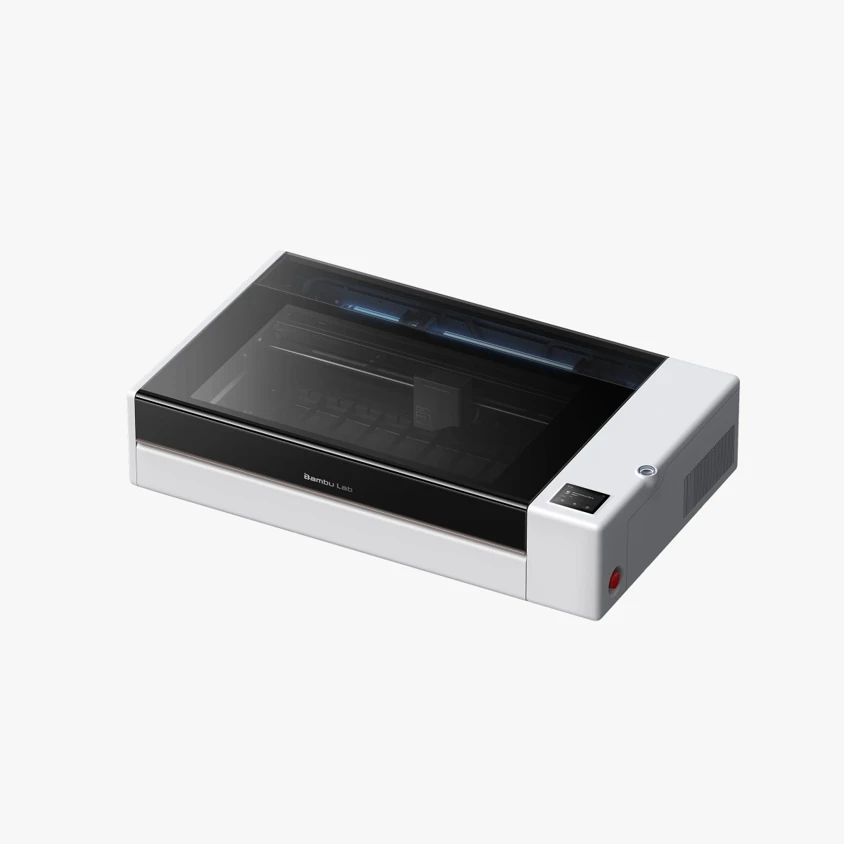
Bambu Lab has released the R1, its first dedicated laser engraver and cutter. The enclosed desktop machine uses a 55 W CO₂ laser over a 600 × 300 mm work area and carries over the camera systems, motion control and guided setup that have become familiar on the company's 3D printers.
The R1 is not a printer with an interchangeable laser head. It is a standalone laser cutter built around automatic optical alignment, camera-assisted job placement and accessories for long or cylindrical workpieces. Bambu Lab rates engraving speed at up to 1,000 mm/s, with acceleration of 20,000 mm/s².
A 55 W CO2 Laser Over 600 × 300 mm
The standard work area measures 600 × 300 mm. Bambu Lab lists wood, acrylic, leather, fabric, paper, EVA foam and shell among the materials the R1 can cut and engrave. Glass, ceramic and coated metal are listed for engraving only; bare metal is not supported for direct engraving.
Cutting depth depends on the focusing lens. With the standard short-focus lens, Bambu Lab rates the R1 for up to 15 mm black-walnut plywood or 20 mm acrylic in one pass. The optional medium- and long-focus lenses raise the plywood figure to 18 mm, while retaining the 20 mm acrylic rating. These are manufacturer test figures, and the product notes specify that its references to wood mean plywood.
The laser head includes air assist rated at 30 L/min at 30 kPa. At the other end of the motion system, Bambu Lab claims absolute accuracy below 0.1 mm across 600 mm when the optional Vision Encoder is fitted.
Automatic Alignment Replaces Mirror Adjustment
CO₂ laser cutters normally require their optical path to be checked and the mirrors adjusted so the beam reaches the lens in the correct position. The R1 automates that process. Its supplied Laser Alignment Sensor mounts on the toolhead, measures the beam and corrects the optical path in about one minute, according to Bambu Lab.
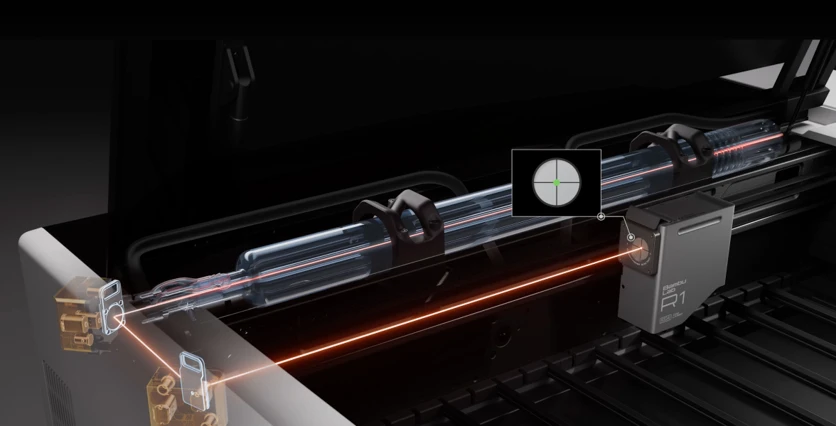
Bambu Lab's alignment sensor measures the beam at the toolhead before the machine corrects the optical path.
Job placement is handled by what Bambu Lab calls TriSense: two cameras, two lasers and two encoders working together. The company specifies positioning accuracy below 0.2 mm. A toolhead camera is used for small objects and for tracing printed or drawn outlines, while automatic ranging measures the surface height, including on clear acrylic and glass.
The R1 also applies vibration compensation after direction changes and adjusts laser output as the head accelerates. Bambu Lab says this keeps engraving depth consistent at higher speeds. Material recognition can load power and speed settings automatically, although this part of the workflow is limited to Bambu Lab's own materials.
The Conveyor Extends the Work Area to Three Metres
An optional automatic conveyor expands the processing area from 600 × 300 mm to 600 × 3,000 mm by feeding long stock through the machine. Bambu Lab positions the accessory for shelving, furniture parts and other projects that would not fit inside the standard enclosure.
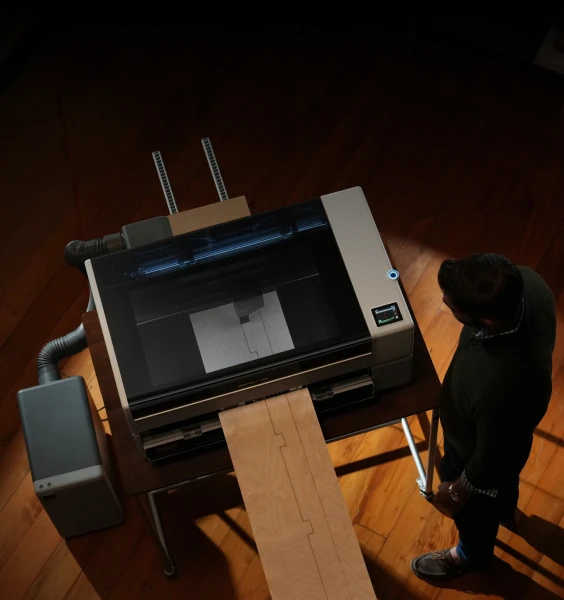
The optional conveyor feeds boards through the R1 for jobs up to three metres long.
The conveyor requires the optional riser base, which also creates clearance for taller workpieces. A rotary attachment mounts to the same raised setup for engraving bottles, cups and other cylindrical objects. At launch, Bambu Lab supports cylindrical processing; support for more complex revolved shapes is listed as a future firmware update.
The Enclosure Is Class 1 Until It Is Opened Up
In its standard enclosed configuration, the R1 is rated as a Class 1 laser product under IEC 60825-1. The lid is interlocked so opening it stops the laser, and the machine includes flame detection and a physical emergency-stop button. A crossflow ventilation system draws fresh air across the work area and sends smoke to the exhaust outlet.
That classification changes when the machine is used with the riser base or automatic conveyor. Both create openings in the enclosure, turning the R1 into a Class 4 installation. Bambu Lab says those configurations are intended for trained professional users and require CO₂ laser-safety eyewear. This is an important distinction for anyone considering the long-material workflow.
The R1 ships with an exhaust fan and hose. Bambu Lab also offers the E1 Pro air purifier as a separate accessory, using several filter stages and activated carbon to capture smoke, fine particles and odors before returning air to the room.
A Laser Cutter Built Around Bambu's Workflow
The R1's main departure from a conventional desktop CO₂ cutter is not the laser power or bed size on its own. It is the effort to move alignment, focusing, material setup and job placement into a guided workflow. The machine has its own touchscreen for job progress, optical calibration and system status, with Bambu Suite providing the design and processing workflow.
Several of the headline capabilities rely on optional hardware. The conveyor, rotary attachment, riser base, medium- and long-focus lenses, Vision Encoder and E1 Pro purifier are all separate purchases. The complete configuration will therefore depend on whether the machine is being used for flat sheet work, long stock or cylindrical engraving.
The launch gives Bambu Lab a dedicated laser platform rather than another multi-function printer. The specifications put the R1 firmly in the desktop CO₂ category; the more consequential claim is that routine setup can be reduced to the kind of camera-led process Bambu Lab users already know. Cutting depth, positioning accuracy and smoke control will need to be assessed in production workflows once machines reach users.
What is the Bambu Lab R1?
The R1 is Bambu Lab's first dedicated laser engraver and cutter. It uses a 55 W CO₂ laser and has a standard working area of 600 × 300 mm.
How large is the Bambu Lab R1 work area?
The enclosed work area measures 600 × 300 mm. With the optional riser base and automatic conveyor, the R1 can process stock up to 600 × 3,000 mm.
How thick can the Bambu Lab R1 cut?
Bambu Lab rates the standard short-focus lens for up to 15 mm black-walnut plywood and 20 mm acrylic in one pass. Optional medium- and long-focus lenses raise the plywood figure to 18 mm. These figures come from Bambu Lab's internal testing.
Is the Bambu Lab R1 a Class 1 laser?
The R1 is rated Class 1 in its standard enclosed configuration. Adding the riser base or conveyor opens the enclosure and changes it to a Class 4 installation that requires CO₂ laser-safety eyewear and trained professional operation.
Does the R1 align the CO2 laser automatically?
Yes. The supplied Laser Alignment Sensor mounts on the toolhead and Bambu Lab says it can measure and correct the optical path in about one minute.
Sources
Share this article
Related articles

Lasers · Aug 13, 2026
Bambu Lab R1 CO2 Laser Cutter Launches September 22
Bambu Lab's latest teaser confirms both the R1's CO₂ laser technology and its September 22 launch date. Power, work area and other specifications have yet to be announced.
2 min read

Lasers · Aug 25, 2026
xTool to Unveil X1 Laser and First Embroidery Machine on August 27
xTool will unveil its new X1 laser system on August 27 alongside what the company describes as its first embroidery machine. According to an initial teaser, the X1 is designed to combine a large working area with the processing speeds normally associated with galvo lasers.
9 min read
UV Printers · Jun 29, 2026
xTool O1 Omni Printer: Prices, Editions, and Ink Costs
xTool says 'from $1,699' for a 4-in-1 that prints on wood, tumblers, and T-shirts. That number is a deposit-locked early bird on the single-head model, and the only edition that does all four jobs is $2,799. Here's every price, the published ink costs, and what it can't do.
19 min read