Creality SPARKX i8 on Indiegogo: Four Color Channels, One Toolhead
David ChacónUpdated 6 min readThis article is also available in:
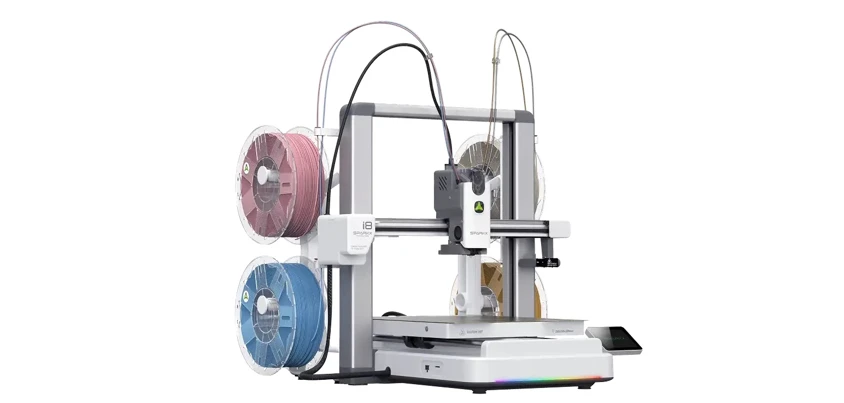
The Creality SPARKX i8 runs four filament channels into one toolhead. Its Indiegogo campaign runs until November 15, and Creality says the first batch of printers left the factory at the end of October.
Contents
Creality launched the SPARKX i8 on Indiegogo on September 21. The opening reward was $289, against a stated retail price of $399. The four-channel machine uses Creality's QuarTeks toolhead to shorten the filament path shared during color changes.
As of November 2, 2026, Creality says the first batch of about 2,000 printers has left the factory, most of it bound for backers in the US and the EU. Mass production has been underway since late September. The company expects the US units at port in early December and the EU units in late December, before customs clearance and local delivery. The campaign, extended on October 29, now runs until November 15.
Indiegogo still shows the $289 launch reward and the $309 early-bird reward, both listed for November delivery. A newer $319 Indiegogo special offer is listed for December. These are crowdfunding rewards rather than normal store orders.
QuarTeks Shortens the Shared Filament Path
The i8 is an open-frame bedslinger with a 260 x 260 x 255 mm build volume. Its QuarTeks toolhead keeps four filaments in separate channels until they meet less than 1 mm from the nozzle. That leaves less filament to retract before the next color enters the nozzle.
Creality's August 19 announcement, a month before the campaign, put that merge point 1.7 mm from the nozzle. Its campaign page later says under 1 mm, and compares that with more than 35 mm in conventional systems. The spec sheet quotes 500 mm/s and 300 °C at the hotend.
The i8 still prints through one nozzle. It does not park a separate toolhead for each color or exchange hotends between changes: the four feeds stay inside the same toolhead. Shortening the shared path reduces the material left from the previous color, but the next filament still passes through that common outlet.
Creality claims a switch takes less than a second. On the i7, the CFS Lite brings the four filaments together before the extruder, as Bambu Lab's AMS does, and changes color by pulling one out and feeding the next in. What has already melted cannot be pulled back, so it is purged through the nozzle. Keeping the channels separate almost the whole way down leaves less to flush.
The campaign also says the i8 can skip a separate prime tower when the model allows it, placing color transitions inside infill or inner walls. Creality calls this zero external purge waste, although the campaign notes a small flush at startup and limits the prime-tower-free mode to compatible models.
Purge-into-infill uses material inside the part rather than collecting it beside the print. A model needs enough suitable internal space to hide those transitions; a small part or one with little infill may still need external purge. The amount of material used therefore depends on the model and slicing settings, not just the toolhead.
Color range is the other half of Creality's pitch. The company presents the i8 as a CMYK printer that layers cyan, magenta, yellow and black filament to create intermediate shades rather than blending the materials in the nozzle. Creality says the process can widen the available palette, but cannot provide precise color matching or reproduce every specified color.
Filament and Support Options
Creality's campaign FAQ lists PLA, silk PLA, PLA-CF, PETG, PETG-CF and dedicated PLA support filament. All four channels share one heating assembly, so Creality recommends keeping to materials with similar printing temperatures. Four colors of PLA or four colors of PETG fit that advice; the machine is not a four-tool system with an independently heated nozzle for each material.
For supports, the FAQ specifically advises against using PLA and PETG directly as support materials for each other on the i8. Instead, Creality offers a dedicated PLA support filament with a similar printing temperature. That distinction matters for anyone planning to use the extra channels for support interfaces rather than simply adding colors.
Four-color printing also works without CFS Lite. The optional feeder adds automatic filament loading, unloading and refilling; it is not required to access the printer's four channels.
First SPARKX i8 Units Leave the Factory
The campaign passed $1 million in funding within 40 minutes, Creality said in a launch-day update. At that stage, the i8 was in final debugging. Its September 29 update confirmed that production had begun, with machines moving through assembly, functional testing and quality checks.
In its October 29 update, Creality said most printers travel by sea in consolidated batches. Of the first batch, about 1,500 units are headed for the US and about 500 for the EU. The company aims to ship about 90% of North American and European orders from the factory by the end of November, and orders in Asia start leaving in November. Backers in South America, Australia, South Korea and Taiwan are waiting on product certification, which Creality expects in late November or December, depending on the region.
Leaving the factory is not delivery, as Creality points out: sea transit, customs and local delivery still follow, and tracking arrives by email once an order ships. The printer rewards still estimate November delivery, while Creality's own plan puts the US and EU port arrivals in December.
Sources
- Creality's SPARKX i8 Indiegogo campaign, for reward prices, delivery estimates and the QuarTeks description
- Creality's campaign FAQ, for supported materials, PLA support filament and optional CFS Lite
- Creality campaign update #3, September 29, for the start of mass production
- Creality campaign update #4, October 29, for the first shipments, regional plans and the campaign extension
- Creality's SPARKX i8 announcement page, for the specifications
Share this article
Related articles
Pricing · Jun 11, 2026
PLA & PETG Filament Price per Gram and per Kg
Most guides quote a price per kilogram from whenever they were written. This page carries dated prices from the manufacturers' own stores and converts them to the number you actually need: cents per gram.
8 min read
3D Printers · Jul 22, 2026
Sovol M1D Price: Seven-Toolhead IDEX Printer, Essential vs Advanced
Sovol's first toolchanger puts seven toolheads on two independent carriages and says it prints seven colors with almost no purge waste. The Kickstarter closed on August 27, and both models are now preorders on Sovol's store: the open-frame Essential at $1,499 and the heated-chamber Advanced at $1,799.
14 min read
3D Printers · Nov 4, 2026
Bambu Lab H3C Launches at $2,499 With Nine Docked Hotends
The Bambu Lab H3C parks nine hotends in a rack and warms the next one while the current one prints, which Bambu claims cuts a material change to about six seconds with almost nothing purged.
7 min read